
Digital Rx
Digital Rx
Upper abdominal ultrasound is a diagnostic technique that allows the examination of the major organs of the upper abdominal cavity. It uses high-frequency sound waves without radiation, making it a safe examination, even for pregnant women and children.
With this study we can assess:
Conventional and specialized studies: abdominal, pelvic, obstetric, thyroid, breast, soft tissue, renal, hepatobiliary, transvaginal, testicular, musculoskeletal, and more.
What is an upper abdominal ultrasound and what is it for?
Upper abdominal ultrasound is a diagnostic technique that allows the examination of the major organs of the upper abdominal cavity. It uses high-frequency sound waves without radiation, making it a safe examination, even for pregnant women and children.
With this study we can assess:
Liver: size, texture, presence of fatty liver, cysts or tumors.
Gallbladder and bile ducts: detect stones, inflammation or polyps.
Pancreas: rule out pancreatitis, cysts, or tumors.
Spleen: Identify abnormal growth (splenomegaly) or lesions.
It is considered the first-line study in patients with abdominal pain, jaundice, suspected gallstones, or liver disorders.
When is it recommended?
The doctor may request it in cases such as:
Persistent abdominal pain.
Inflammation of the pancreas (pancreatitis).
Suspected gallstones (cholelithiasis)
Enlargement of the spleen (splenomegaly).
Liver diseases (hepatitis, cirrhosis, fatty liver).
Suspected tumors, cysts, or abscesses.
Study Preparation
To obtain clear and reliable images:
Fast for 6 to 8 hours (do not eat or drink anything except water).
Avoid very fatty foods the day before.
Do not consume soft drinks or carbonated beverages to avoid gas.
Take regular medications with little water, unless medically indicated.
In some cases, your doctor may combine it with other abdominal studies (e.g., pelvic ultrasound).
At UniRad, you'll receive personalized instructions tailored to your needs.
How is an ultrasound performed?
Registration at reception and brief clinical interview.
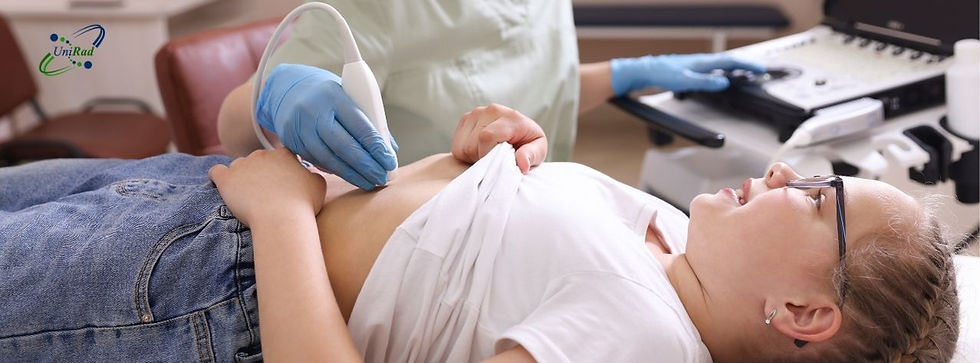
The patient lies supine (face up).
A conductive gel is applied to the skin to improve wave transmission.
The radiologist moves the transducer over the upper abdomen.
During the exam, you may be asked to take deep breaths or change position to better view the organs.
The procedure takes 10–15 minutes, is safe, fast and painless.
Why choose UniRad for your ultrasound in Mérida?
Instant digital image delivery | If you need urgent interpretation, let us know. We have multiple solutions for you and your family.

Speed and efficiency
Results in minutes and medical report within 24 hours.

Personalized attention
Human support before, during and after the study.

Advanced digital technology
Clear images with state-of-the-art equipment.

Strategic location
Altabrisa and Cd. Caucel branches with private parking.
Study Process at UniRad
Our processes, from the moment you arrive at UniRad, are very simple, efficient, and decisive.
Arrival
Your Study
Express Medical Interpretation starting within 24 hours.
Send Images Quickly
Arrival and check-in
Responsible quick study.
Instant digital images
Interpretación médica en 24h
Quote your Studio It's free!
If you need a specific study or it is not shown in our section, ask about it, we surely have the study for you.
FAQ Frequently Asked Questions
Frequently Asked Questions about Upper Abdominal Ultrasound in Merida, Yucatan.
What is the difference between an upper abdominal ultrasound and a complete abdominal ultrasound?
An upper abdominal ultrasound focuses on the liver, gallbladder, bile ducts, pancreas, and spleen. A comprehensive ultrasound also includes the kidneys, bladder, and pelvic organs. Your doctor orders an upper abdominal ultrasound when clinical suspicion is related to liver, biliary, or pancreatic diseases.
Is this test useful for detecting fatty liver?
Yes. It is the most widely used technique to identify hepatic steatosis (fatty liver). It allows for assessing the degree of involvement and monitoring patients with diabetes, obesity, or alcohol consumption.
What happens if I have gas in my intestines?
Excessive intestinal gas can make it difficult to visualize the pancreas and part of the bile ducts. This is why fasting for 6–8 hours is so important: it improves the acoustic window and ensures a reliable diagnosis.
Can it detect tumors or cancer in the liver or pancreas?
Yes, although ultrasound is an initial test. It can identify masses, cysts, suspicious lesions, or tumors. In case of abnormal findings, a CT scan or MRI is recommended for greater accuracy.
Is it safe to do it on pregnant women and children?
100%. It doesn't use radiation, only sound waves. In fact, it's the same technology used in obstetric ultrasounds to check the baby.
How long does the study take and when will I receive the results?
The study takes between 10 and 15 minutes. The images are delivered instantly digitally (email/WhatsApp), and the interpreted medical report is sent up to 24 hours later.
Can it be done if I am undergoing medical treatment or after surgery?
Yes. It is useful as part of postoperative follow-up (e.g., gallbladder or liver surgery) or to manage chronic diseases. It does not interfere with treatments or medications.
How should I report to the study if I have diabetes?
Patients with diabetes should inform their radiologist. In some cases, a small, light breakfast or medication schedule adjustments may be allowed to minimize adverse effects on glucose control. UniRad offers personalized instructions for each patient.
What advantages does UniRad offer compared to other offices in Mérida?
State-of-the-art equipment with clear images.
Protocols of minimum discomfort and maximum precision.
Fast and accessible digital results.
Personalized attention, not massive.
Reliable medical reports from 24 hours ago, prepared by radiology specialists.